
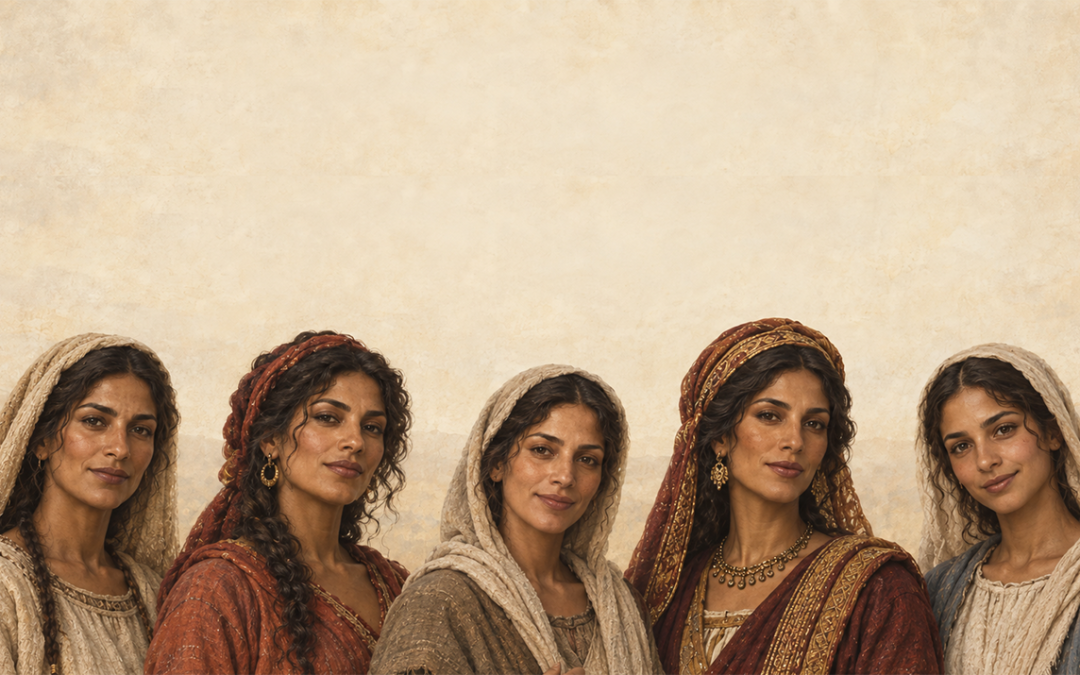
From Ruin to Royalty: What the Women in Yeshua’s Lineage Reveal about Redemption
What if your family tree included a woman who had to disguise herself in order to get her father-in-law to honor his word? Or a Canaanite innkeeper with a notorious past? What about a foreigner from a despised nation, an adulterous royal scandal that led to murder, or a young unmarried woman facing public disgrace?
Most biographers would scrub those stories to protect a royal reputation. Yet when Matthew opens his Gospel with the legal lineage of Messiah, he explicitly names Tamar, Rahab, Ruth, “the wife of Uriah,” and Mary, Yeshua’s mother. In doing so, he shatters ancient custom and turns a male-dominated archive into an explosive declaration of covenant grace.
If you skipped this genealogy, you missed a masterclass in how God preserves His promise through unexpected and non-traditional circumstances. Yeshua’s earthly ‘family tree’ also serves as a testament to how scandal and grace can co-exist in the context of redemption.
Ancient Record-Keeping: How Matthew Breaks the Mold
To appreciate why Matthew’s opening chapter is so radical, we first have to step into the world of First-Century Second Temple record keeping.
In Ancient Near Eastern cultures, a genealogy was far more than an exercise in family heritage. It was a legal title deed. Genealogies established tribal identity, inheritance rights, land claims, and eligibility for the priesthood or royalty.1 Because legal standing, lineage, and authority were passed strictly through the male head of the household, official genealogical records were overwhelmingly patriarchal.
Women were rarely, if ever, named.
When a record did happen to reference a woman, it was typically a matriarch of unquestioned status and pedigree—think Sarah, Rebekah, Leah or Rachel.2 Naming a mother in a royal line was meant to reinforce purity, noble status, and honor.
Yet Matthew turns this convention on its head.
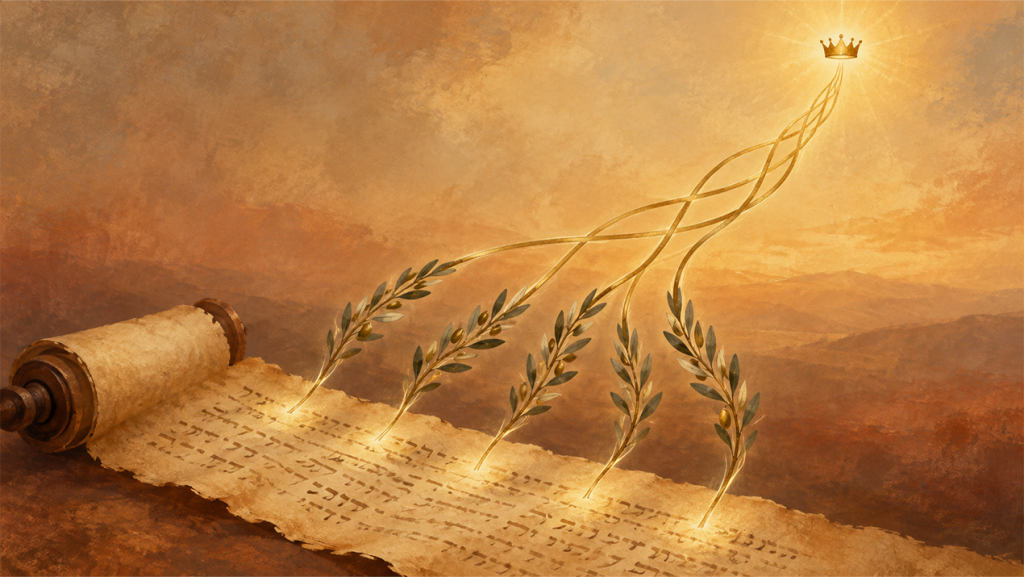
Instead of hiding the complex threads of Messiah’s lineage, he takes his reed pen and writes the names of five specific women directly on his scroll. Even more striking is who he selects. He doesn’t mention Sarah or Rebekah; he names five women whose stories carry heavy tones of moral complexity, foreign blood, social vulnerability, or public scandal.
Matthew’s deliberate departure from standard ancient record-keeping sends an unmistakable signal to his readers right from the start: the kingdom of Messiah does not operate on human status, racial purity, or social reputation. It operates on covenant grace that is put on full display for everyone to see.
This is especially remarkable since we live in a time where social media is quick to condemn women who don’t fit our rules for righteousness.
To see how grace intersects with human ruin in each case, let us turn to the specific stories of the five women themselves.
The Five Matriarchs Included in the Royal Line
At first glance, the story of Tamar and her father-in-law Judah reads more like the “desperate times call for desperate measures” idiom believed to have originated with Hippocrates. But biblical reckoning is different
While secular ‘desperate measures’ often imply abandoning clear scriptural guardrails to achieve one’s own ends, Scripture tells us to work within the guardrails through faith and persistent prayer.
Tamar, the childless widow, never expected Judah to betray his pledge to give her his son Shelah in accordance with Hebrew tradition that ensured that the family line would go on. But out of fear that Shelah might die as his two other (wicked) sons did, Judah reneged, leaving Tamar desperate, destitute, and trapped in perpetual widowhood. (Genesis 38)
Disguising herself as a roadside prostitute and ultimately entrapping Judah in a sexual liaison, she strategically demanded his signet ring, cord, and staff. When he insisted that she be stoned for her indiscretion, the tables turned rather dramatically. Judah ultimately admits that Tamar was more righteous than he was.
Judah’s admission no doubt grew out of a moment of profound embarrassment and spiritual collapse. And two things come to the forefront: his hypocrisy is exposed, and he is shown to be the actual covenant breaker!3
It is interesting how the Bible handles this. Tamar’s story appears to have been reframed as a pursuit of justice rather than moral failure. Her actions can be viewed through the lens of ancient covenant loyalty and the preservation of Judah’s line through the birth of twins; her son Perez becoming the direct ancestor of King David and Yeshua.
In Matthew’s genealogy, Tamar and Rahab are linked by the thread of messianic promise rather than culture. In this we see how God worked through different eras, cultural landscapes, and unlikely people across the centuries to build a Royal house.4
While it is almost certain that Rahab was a Canaanite, it is unclear as to her occupation at the time she encountered the 2 spies of Israel (Joshua 2:1). The arguments seem to center around whether she was a prostitute, an innkeeper, or maybe both.5
Whether Rahab was an innkeeper whose establishment served as a strategic military drop-point or a woman from a broken, pagan past who renounced her former life, her legal transformation under Torah law is clear: she forsook Jericho’s gods, bound herself by covenant oath to YHWH (Joshua 2:11), and legally entered the lineage of Judah through her marriage to Salmon6 (Matthew 1:5).
In a single generation, an outsider from a condemned culture was brought into the royal house of Israel. The messianic thread didn’t end there: Salmon and Rahab’s son, Boaz, would go on to weave yet another unlikely story into the lineage by taking a Moabite woman named Ruth as his bride. Their son Obed would become King David’s grandfather. (Ruth 4:21)
What do a Canaanite and a Moabite have in common? When evaluated through Hebraic law, they both represent cursed cultures. Canaanites faced divine judgment under the conquest mandate of Deuteronomy 20:16–17, while Moabites were explicitly excluded from entering the assembly of YHWH even to the tenth generation in Deuteronomy 23:3. Yet, through covenant loyalty (chesed), both Rahab the Canaanite and Ruth the Moabite bypassed their national curses to become matriarchs in the royal line of Messiah.7
Then there’s the ‘other woman’ Matthew identifies not by name, but with these four words: “the wife of Uriah.” We all know her name is Bathsheba so why not just come out and say it?
This was deliberate on Matthews’ part in a way that is heartbreakingly beautiful. This intentional omission does two things: it lays out David’s sin and keeps Uriah, the innocent and wronged husband, in Israel’s history. So, instead of allowing the genealogy to simply read ‘David was the father of Solomon by Bathsheba’, Matthew repeatedly draws unexpected attention back to the scandal-marked history of the Messianic line.
Some scholars believe that the label “wife of Uriah” may also be serving a theological purpose. Since Uriah was a Hittite (2 Samuel 11:3) we can also see God’s hand in extending His purposes beyond Israel’s conventional faith boundaries. And, we can’t help but juxtapose the faithfulness of this man against David’s betrayal. Matthew is essentially saying, “See what happened here. Yeshua’s genealogy does not try to hide the beloved King’s sin.”
In his article “Tamar’s Ancestry and Rahab’s Marriage: Two Problems in the Matthean Genealogy” Professor Richard Bauckham favors the widespread scholarly view that Matthew included these women because they were considered Gentiles. This may serve to foreshadow the inclusion of Gentiles in the Gospel’s mission of going into all the world.
Matthew’s genealogy is doing something much more profound than just pointing us to Yeshua’s ancestors. It is quietly whispering that our Messiah has entered messy humanity with all its scandal and suffering. He shows us that it was the Father’s plan all along to include outsiders.
Notice the pattern that runs through the mid section of Messiah’s genealogy. Tamar connects to Canaan through her father-in-law Judah, Rahab married into the tribe by Salmon, Ruth goes through Bethlehem to land in David’s family, and Solomon comes through the aftermath of adultery and murder to continue the line. And ultimately comes Mary’s miraculous pregnancy.
Matthew blesses us with the knowledge that through Mary, our Messiah Yeshua chose to enter this realm of genuine human suffering–a world of sin, outsiders, broken families, injustice, foreigners–in order to bring unmerited mercy and love.
Then, Yeshua tells us to “Go and make disciples of all nations.”
This is why you should never skip the genealogies. They hold hidden truths and insights that only the spiritually hungry would ever crave. This truth is unmistakable: the Messiah comes through Israel but he comes for the nations too.
So, stop now and read through Matthew’s genealogy again and discover what the Ruach may be trying to show you.
Footnotes:
1 Tribal identity and census records (Numbers 1:2; 18). Inheritance and land claims (Numbers 27:8-11; 36:8) Eligibility for the Priesthood (Ezra 2:62, Nehemiah 7:64, Numbers 3:10), Eligibility for Royalty (2 Samuel 7:12-16, Ruth 4:18-22)
2 In Genesis 11:29 Sarai (Sarah) is named alongside Milcah in the family record of Terah’s descendants. Rebekah is formally introduced in the genealogical report of Abraham’s brother Nahor in Genesis 22:20-23. Rachel & Leah are mentioned in Genesis 46:8-25.
3 This chronological argument has a long history in biblical commentary, going back to 18th-century scholars like William Hales, who calculated from Genesis 46:12 that Judah could have been no older than his teens when Er was born. Readers interested in the broader chronology debate may want to consult modern commentaries by Gordon Wenham, Robert Alter, or Nahum Sarna.
4 Tamar and Rahab were not contemporaries. They lived approximately 300-400 years apart during entirely different eras of Israel’s history.
5 The standard reading of zonah from the Hebrew root zanah (to commit fornication) means prostitute. The historical (Targum) reading translates zonah as pundeketa/innkeeper. In Ancient Near East city-states, inns located on outer defensive walls were hubs for intelligence gathering (military), travel, and commerce.
6 Interesting side note regarding Salmon, the father of Boaz: When Joshua chose leaders for the spy mission to Jericho, choosing the son of Judah’s chief leader (Nahshon, son of Amminadab) aligns with ANE military precedent. Commentators on Matthew’s genealogy have conjectured that Salmon may have been one of the two spies. This conjecture appears among several commentators on Matthew’s genealogy. In Joshua 2:12-14 Rahab not only committed an act of treason against the King of Jericho, but she asked for a ‘token’; a binding covenant guarantee of life and protections for her father’s house. A marital union between the house of the prince who benefited from the oath (Salmon) and the one who preserved the mission (Rahab) reflects ANE honor-covenant culture.
7 In Ancient Near Eastern (ANE) legal structures and classical Hebraic jurisprudence, tribal identity, clan membership, and lineage were traced exclusively through the father (patrilineal descent). Because of this, the statutory prohibitions in the Torah applied differently to men and women regarding marriage and community inclusion.